Dedicated to covering the visual arts community in Connecticut.

Monday, February 11, 2013

Upcoming receptions, other events, for "Nudes and Nudibranchs" at Kehler Liddell

Kehler Liddell Gallery
873 Whalley Ave., New Haven, (203) 389-9555
Nudes and Nudibranchs: An Exhibition of Paintings and Sculpture
Through Mar. 10, 2013.
Artist Reception with Frank Bruckmann and Gar Waterman: Sat., Feb. 16, 2—4 p.m. followed by "Poetry and Chocolates" (see below) from 4—6 p.m.
Artist Reception with Frank Bruckmann and Gar Waterman: Sun., Feb. 24, 2—4 p.m.
"Conspicuous Cocktails" (see below): Sat., Mar. 2, 2—4 p.m.

Press release from Kehler Liddell Gallery

Award-winning painter Frank Bruckmann and sculptor Gar Waterman will exhibit their most recent work at the Kehler Liddell Gallery: Nudes and Nudibranchs, from Feb. 7—Mar. 10, 2013. Because of the disruptions caused by Blizzard Nemo, there will be make-up artists' receptions on Sat., Feb. 16, from 2—4 p.m. (followed by "Poetry and Chocolates" from 4—6 p.m.) and Sun., Feb. 24, from 2—4 p.m.

Frank Bruckmann: "Home Library"


Frank Bruckmann and Gar Waterman are both traditionalists who use direct observation of nature and carefully applied technique to craft their work. Bruckmann's brushstrokes caress oil paint with an expert and familiar hand into the eternally complex landscape of the female figure, while Waterman's sculpture bends the liquid sheen of polished stone into impressions of rhythm and grace from the marine environment. Their work is beautiful, but its beauty is not confined to the surface. Instead, it wells up through the underlying layers of paint and stone, brush and chisel strokes revealing the more complex alchemy of their creative process.

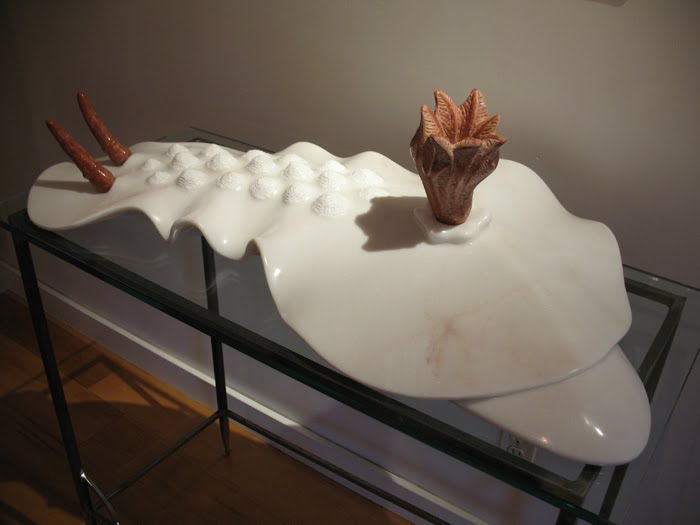
Gar Waterman: "Humboldt Squid"


Meet artists, art patrons, neighbors and friends at Kehler Liddell Gallery, one of Connecticut's premiere retail arts venues, located in the heart of historic Westville Village. Cultural and culinary happenings during Bruckmann and Waterman's exhibit will include:

· Sat., Feb. 16, 4—6 p.m."Poetry and Chocolates." Samples of exquisite chocolates, generously provided by Chocopolgie, will accompany poetry recitations by SCSU faculty and MFA candidates.

· Sat., Mar. 2, 2—4 p.m. "Conspicuous Cocktails." An exotic drink-tasting event with restaurant 116 Crown's John Gianetti, CT's hottest mixologist.

Labels: , , , , ,

Wednesday, July 11, 2012

Saturday evening opening for group show at Ulla Surland in Fairfield

Ulla Surland Gallery Eleven
11 Unquowa Rd., Fairfield, (203) 259-1572
Water: A Group Exhibition
July 14—Aug. 31, 2012.
Opening Reception: Sat., July 14, 6—8 p.m.

Press release from the Ulla Surland Gallery

Marianne Van Lent—Fresco Secco & Dispersed Pigment on Canvas
Brechin Morgan—Acrylic on Canvas
Janis Melone—Collage/Mixed Media
Rebecca Harper—Oil on Canvas
David Dunlop—Oil on Metal
Ann Conrad—Intaglio Prints with Hand Coloring
Frank Bruckmann—Oil on Canva

Where there is no water, there is no life as we know it. Water covers 71% of the earth's surface. It exists in the universe in vast quantities, it's components, hydrogen and oxygen, among the most plentiful of the elements. Water vapor along with carbon dioxide create a buffer around the earth keeping the temperature stable and within a range that supports life.

Too much water as in floods, and combined with energy as in tsunamis and hurricanes causes cataclysmic destruction. Scarcity of water creates deserts where life exists only in the rarest forms and with difficulty. Civilizations rise and prosper in the fertile land around rivers and in the temperate zones where oceans meet land masses. Waterways are used as pathways of transportation, as receptacles of waste, for recreation, and when harnessed, to produce energy. Water is used for food preparation, to extinguish fires, for bathing, to cool our nuclear reactors, quench the thirst of factory farms, and in religious ritual.

Volumes have been written about water in all its forms and uses, from the world of science and the finite, to the world of science fiction and the infinite and in the places where they meet and combine. The seven artists participating in this exhibition using their creative voices have used water as inspiration for works of art. The works are literal and abstract, sometimes both, small and large, and use a variety of materials, scales and dimensions, expressing the poetic, the factual, the surreal and the fantastic.

The show will be on view from July 14 through Aug. 31. There will be an opening reception this Sat., July 14, from 6—8 p.m.

(Image: "Bitmap XIV" by Ann Conrad.)

Labels: , , , , , , , , , , ,

Wednesday, June 01, 2011

Thursday reception for CCT Artist Fellowship recipients

Connecticut Commission on Culture and Tourism
One Constitution Plaza, 2nd Floor, Hartford, (860) 256-2800
Second Glance
Through July 15, 2011.
Reception: Thurs., June 2, 4:30—6:30 p.m.

Press release

Second Glance is an exhibition of photographs, works on paper, paintings, sculpture/installations and poetry created by past recipients of the Connecticut Commission on Culture & Tourism ("CCT") Artist Fellowship program. The artworks in this exhibit present multiple interpretations that reward viewers through prolonged experience.


Participating artists include Matthias Alfen (Norwalk), Frank Bruckmann (New Haven), Anne Cubberly (Hartford), Sean Kernan (Branford), Kristina Kuester-Witt (Woodbridge), Jeff Mock (New Haven), Jeffrey Pan (Stonington), Ronnie Rysz (New Haven).

Labels: , , , , , , , ,

Thursday, January 27, 2011

Sunday opening at Kehler Liddell Gallery in New Haven

Kehler Liddell Gallery
873 Whalley Ave., New Haven, (203) 389-9555
I…and Love…and You
Jan. 27—Mar. 6, 2011
Opening reception: Sun., Jan. 30, 3—6 p.m., with Artists’ Talk at 3 p.m.

Press release

Kehler Liddell Gallery is pleased to present I…and Love…and You, a group exhibition of paintings, photographs, sculpture and works on paper that examine the contemporary complexities of honest communication in exchanges related to love. Artists include: Joseph Adolphe, Edith Borax-Morrison, Amy Browning, Frank Bruckmann, Jason Buening, Susan Clinard, Rod Cook, Emilia Dubicki, Matthew Garrett, John Harris, Lisa Hesselgrave, Gigi Horr Liverant, Blinn Jacobs, Keith Johnson, Kristina Kuester-Witt, Lawrence Morelli, Hank Paper, Joseph Saccio, Gerald Saladyga, Deirdre Schiffer, Alan Shulik, Gar Waterman and Marjorie Wolfe.

The title of the exhibition references an indie-folk song by the Avett Brothers that tells the story of a man who cannot utter the simple phrase “I love you.” He is plagued by the radical differences between speaking and acting on feelings of love and hate. He fights with words, preferring verbal attacks to physical attacks, and loves with action, preferring courtship to intimate profession.

The show will illuminate the great love dysfunctions of our time, place and culture by addressing the quiet underpinnings of love and its converse aspects, such as: romance and sex, ambiguity and directness, polygamy and monogamy, naiveté and maturity, honesty and deceit, and madness and betrothal.

A selection of works will investigate the psychological dimensions of love that arise in Harold Pinter’s 1963 play, “The Lover.” The 50-minute play follows the erotic escapades of a long-married British couple that engage in an afternoon of fantasy role-playing. The husband makes 3 visits to his house as an illicit “lover,” assuming the role of a young park keep, an aggressive mugger and a kidnapper. The couple forces each other into and out of jealousy in a series of small actions that raise the drama to uncomfortable boiling points.

During the run of “I and Love and You”, Elm Shakespeare Company will perform eight nights of “The Lover.” The theatrical stage will occupy the center of the gallery, and seating will take place in the round, so that the set and audience will be surrounded by the works. In this setting, the play will act out themes expressed in the images: power struggles, verbal dominance, game playing, moving beyond reason, and falling out of love.

Performances will take place February 3—6 & 10—13; Thursday-Friday: 8 p.m.; Saturday: 8 and 10 p.m.; Sunday 4 p.m. Tickets are $20 in advance, $25 at the door. The Special Benefit Performance will take place on Friday, February 11, 6:30 p.m., $75 per ticket; hors d'oeuvres and wine will be served. Please visit the Elm Shakespeare Company Web site for tickets.

Labels: , , , , , , , , , , ,

Wednesday, December 08, 2010

Bruckmann/Clinard show reception Sunday afternoon at Kehler Liddell in Westville

Kehler Liddell Gallery
873 Whalley Ave., New Haven, (203) 389-9555
Frank Bruckmann & Susan Clinard: New Work
Dec. 9, 2010—Jan. 19, 2011
Opening Reception: Sun., Dec. 12, 3—6 p.m.

Press release

Kehler Liddell Gallery is pleased to present a two-person exhibition of new paintings by Frank Bruckmann and new sculpture by Susan Clinard that revel in the spirit of anti-technology art to communicate emotion and allegory.

Before moving to New Haven, Frank Bruckmann studied at École des Beaux-Arts in Paris, where he spent nearly a decade in France and Spain coping the masters in the great museums and painting landscapes in the cities and countryside. These years of intense study inform his rich palette and humanist depictions of contemporary America, which provide him with endless sources of inspiration. Both a plein air and studio painter, Bruckmann paints that which surrounds him. Past series depict local merchants in their shops, cityscapes of downtown New Haven, sublime views of West Rock, and landscapes of Monhegan Island, Maine, where he frequently travels.

For this show, Bruckmann will present new small and medium sized paintings of the volcanic Gabbro rocks in Monhegan that are more detailed and abstract than anything he has done before. The paintings investigate the mysterious surfaces and orifices of the purple-black rocks, delicately cut by white lines (quartz) and speckled with orange clusters (fungi). The paintings investigate new textures, shadows, colors, and reveal secret biological world that fights to live in places the human eye cannot see.

Susan Clinard is one of those rare artists who can work in wood, clay, bronze, stone and metal. Real people, experiences, and stories inspire and inform her work, which confront issues of inequality, fear, compassion and courage. Since giving birth to her first son in 2004, motherhood and life cycles have become major semi-autobiographical themes. For this show, Clinard has treaded on radical new ground, and will present a series of mixed media wunderkammers, (“cabinets of curiosities”). Wunderkammers were popular toys of nobles in the late 1500ʼs, before the advent of public museums. These cabinets, ranging from small boxes to library-sized rooms included collections of oddities that belonged to a specific natural history—precious minerals, strange organisms, indigenous crafts, collected from civilizations and placed in a microcosmic memory theatre. Clinardʼs wunderkammers incorporate this idea of the biological unknown, and organize the various found elements in compartments that suggest an internal, psychological narrative. Each cabinet shelters its own landscapes, precious moments, and measurements of darkness and clarity.

Clinard will also present a new major installation titled “Procession,” which incorporates figurative elements that she is known for. Unlike her traditional clay busts, the line of male figures is roughly cut, minimal and distorted. Positioned on a wheeled platform, the men move in a unified direction with a clear purpose, lending to a strong compositional impact. The work responds to the ceremonial weight and cultural significance of processions in contemporary and ancient history—their association with life, death and strength in unity.

There will be an opening reception for this show this Sun., Dec. 12, from 3—6 p.m., with an artists' talk at 3 p.m. and live music by oud player Qusai Al Bakri.

Labels: , , , ,

Monday, October 04, 2010

2010 City-Wide Open Studios weekend 2, Saturday

On the perfect Saturday of CWOS 2010's second weekend, I checked out the work of sculptor Gar Waterman and painter Joseph Adolphe at Waterman's West Rock Studio. In the front gallery, Waterman was showing a series of sea creatures, sculpted in onyx and marble. The walls were lined with landscape paintings Adolphe made during a sojourn to Italy this past summer.

Adolphe wasn't there when I visited but Waterman was. As always, he was an engaging, humorous and educational host. Waterman—whose father Stan Waterman is a renowned deep-sea diver and producer of underwater films—is presently trying to organize a traveling art/science exhibit around the subject of nudibranchs.

Don't know what a nudibranch is? (The word means "naked gill" in Latin.) Well, Waterman will be more than happy to share his knowledge of and affection for these sea creatures. He led several of us from the front gallery back into his studio for a seminar on the critters and the role they are presently playing in his art.

Waterman said nudibranchs are commonly known as "sea slugs" but that term was a misnomer.

"They are some of the most fabulous, colorful, exotic, wonderful, varied, strange creatures there are," he said. A type of gastropod mollusk like snails, "they evolved away from carrying a heavy calcium shell as protection to [using] chemical protection, because they are toxic."

Flipping through a book filled with pictures of the rambunctiously colored mollusks, Waterman noted that there are over 3,500 known varieties. Members of the diving community love them, said Waterman. They are particular favorites of underwater photographers, according to Waterman, "because unlike the bigger marine creatures they don’t move fast." A photographer can move in close with his or her macro lens and click away.


The group of bicyclists led by Devil’s Gear bike shop owner Matt Feiner showed up at that point and Waterman, like a carnival pitchman, declared, "This is the nudibranch production center of New Haven!"

"Who doesn't know what a nudibranch is? Raise your hand," said Waterman. As most hands went up, he responded, "Well, come in here and I will blow your mind!"

The ebullient host flipped through the pages of one of his books, showing off the images and explaining their physiology. He was particularly amused by the term "parapodal appendages," which refers to body structures some nudibranchs grow to protect their gill plumes. But he was serious too, noting that the creatures' toxins are so sophisticated that they are being studied for cancer research. Additionally, the nudibranchs are current indicators of marine health. They feed on coral reefs so an absence of nudibranchs could indicate problems with the reefs.

"There is a whole crazy world of people even nuttier than I am about these creatures," declared Waterman, referencing SlugJunkie.com, just one of many Web sites devoted to nudibranchphilia. (There is even a blog post about Waterman's sculptures at SlugJunkie.com.)

Like any good entertainer, Waterman knows he needs to give his audience what they came for and he didn't disappoint. He directed the group over to a piece in process to both show his version of parapodal appendages and explain his sculptural method. Waterman described how he will finish the onyx sculpture—already graced with lithe curves and protruding appendages—with selective polishing, leaving some areas rough for variety.

All his work, Waterman said, is nature-connected. In the past, he has created stone, wood and metal sculptures based on insect and seed forms as well as sea creatures. He showed the bicyclists a display case with seed pods that he uses for inspiration, noting with particular enthusiasm the ingenious design of the devil's claw seed pod.

After they left, I talked with Waterman about how he got started on his nudibranch "bender." As a diver, he said, he had loved them since he was a kid. But it was only within the past few years that he started working on realizing them in his sculptures.

The whole idea of a collaborative show for science museums arose out of a fundraiser a couple of years ago for a marine environmental group in Maine. The benefit was a celebration of his father's 86th birthday and 60 years underwater. Waterman recalled that in a bit of serendipity he saw a piece of stone that looked like a nudibranch.

"I didn't set out deliberately at the beginning to do what I'm doing," Waterman said. It's a way of pulling together all these pieces of his life, Waterman said: his years diving and growing up underwater, the people he knows through his father who are the "crème de la crème" of that scientific community and, of course, his art.


"To access that and take advantage of that is really fun for me," Waterman said. "And it's for a good cause—to raise awareness of the environment and biodiversity and what we stand to lose."

•••

Because painter Joseph Adolphe wasn't there when I dropped by I couldn't speak to him about his paintings. But they spoke eloquently for themselves. Adolphe made all of them this past summer during a trip he took with a class he teaches at St. John's University in New York.


All the paintings were oil on board landscapes, specifically of ruins in Italy. Adolphe's approach, which involved liberal use of a palette knife, was wonderfully suited to the imagery. The painting surfaces are full of energy and texture—evocative of the crumbling facades of the ancient ruins—without losing a bit of their pictorial punch.

•••

Across the street Frank Bruckmann was also showing paintings from a recent sojourn. Bruckmann's series of seascapes and shore images were all painted between January and August of this year in the isolated locale of Monhegan Island off the coast of Maine. Monhegan, according to Bruckmann, is accessible by an hour-long ferry ride an hour north of Portland.

Bruckmann said he and his family just "lucked out" in getting the rental for the extended stay. They have usually vacationed there in the summer or early fall. It was a treat for Bruckmann to experience the landscape at a different time of the year. He enthused about "the snow and the light on the horizon. Having winter light was just spectacular."

There was pretty much nothing to do but paint (and spend time with his family). Most of the painting was done outdoors on site in the cold with a little touching up in the studio.

The paintings "Cemetery" and "Whitehead" capture a dulcet combination of light and cast shadow. (I assumed the shadows were from clouds but Bruckmann corrected me.) The hues communicate the frigidity of the season.

Shadows also play a role in enhancing the dramatic impact of an untitled painting of Lobster Cove. The foreground is draped in shadows. The ocean is in the background behind an outcropping of rock. Bruckmann had planned to set up his easel and paint in the open meadow but the wind was so relentless that he moved back into a stand of trees for shelter. The benefits were aesthetic as well as physical. The foreground shadows cast by the trees contrast nicely with the winter sunshine on the brown brush in the middle ground.


•••

Ronnie Rysz's work has evolved quite dramatically over the past half decade. Visiting with Rysz in his 91 Shelton Avenue studio in New Haven, he pulled out a figure painting he made in 2005 while still in college. The small painting of a heavyset nude woman was done in a "classic progressive realist," as Rysz described it. It is accomplished but not striking. Rysz's current work, on the other hand, bursts with personality, style and graphic energy.

"I'm thankful for the skills I earned in school because without them I couldn't do what I'm doing now," Rysz told me.

Rysz was displaying a selection of mixed media paintings and prints—linocuts, woodcuts and multi-plate lithographs. His work synthesizes a wide range of influences: WPA muralists like Thomas Hart Benton, German Expressionism, Frank Stella, Pop Art master Roy Lichtenstein, graphic novelist Charles Burns and more.

His mixed media paintings generally start with a pencil drawing, usually referencing photographic imagery of random models drawn from video or film stills, advertising and other sources. From the pencil sketches, Rysz develops black and white drawings. He builds up layers with cutouts, adding color palettes, embossing. Along with canvas and paper, his mixed media paintings often incorporate wrapping paper, wallpaper, enamel and acrylic paints, industrial screening (which achieves a Lichtenstein-esque halftone effect), rhinestones, jewelry he's found and other found objects.
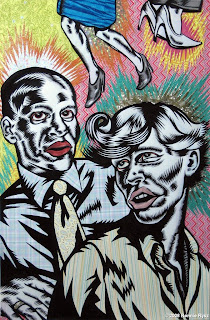


"It's a pretty involved process," said Rysz. "There are many, many layers of papers, painted papers, pre-made papers."

Losing All Touch, his most recent solo show, at the 22 Haviland Street Gallery in South Norwalk, dealt with the way digital media and social networking is alienating individuals from the physical proximity of direct communication. Many of the works shown in Losing All Touch were on display in Rysz's studio. According to Rysz, his subjects "are disconnected, aloof and distracted."

That the works are a commentary on the alienation inherent in online mediation of social relationships is not immediately obvious. It doesn't matter. Rysz's conception is just a further interesting layer to works that stand strong on visual appeal alone.

•••

My final stop of Saturday was at Ben Hecht's studio in Hamden. Hecht was displaying charcoal figure drawings, paintings of military jackets and egg tempera paintings.

The series of military jackets was partially influenced by the presence of veterans of the current wars in the media today. But even more, Hecht was inspired by family members who served in the military. The jackets he was painting were the jackets of family members.

"When you are growing up, you learn that someone fought in such and such war," Hecht said. But what we learn about wars is often from the movies rather than directly from the (mostly) men who fought. Hecht said he built up a duality of reality and fantasy. "I deal with the reality of their experience in war through the artifact of their uniform."

Hecht noted that one of the paintings was of the uniform of his grandfather, a veteran of World War II. The duality of fantasy and reality has visual corollaries in the light used in that painting: warm and cool, natural and artificial.

"Part of the fantasy you have of the artifact is that that’s what they wore in action," said Hecht. "Then to hear from my grandfather that this jacket was what he was given when he returned, and he was several sizes smaller. Their real jackets were destroyed before they were shipped home."

Labels: , , , , , , , ,