Dedicated to covering the visual arts community in Connecticut.

Saturday, September 15, 2012

"Five Course Meal" exhibit artists' reception Tuesday at Katalina's in New Haven

Katalina's Cupcake Shop
74 Whitney Ave., New Haven, (203) 891-7998
Five Course Meal
Through Nov. 2, 2012.
Artists' reception: Tues., Sept. 18, 5—7 p.m.

Press release

The Arts Council of Greater New Haven presents Five Course Meal, an exhibition of works by Connecticut artists Joan Fitzsimmons, Laura Barr, Alexis Neider, Barbara Marks, and Lisa Hess Hesselgrave.

The exhibition will take place at Katalina’s cupcake shop at 74 Whitney Avenue, New Haven, and will be on display from Sept. 10—Nov. 2, 2012. Katalina’s is open to the public during business hours, Monday to Friday, 8:30 a.m. to 7 p.m., and Saturday from 9 a.m. to 6 p.m.

An artists’ reception is scheduled for Tues., Sept. 18, from 5—7 p.m. The public is invited to attend. Refreshments and light appetizers will be served, including cupcakes, of course!

The exhibit will feature artwork that revolves around the theme of food, including colorful and playful paintings of indulgent breakfasts and black and white photographs of emptied glasses. The exhibition, curated by our Director of Artistic Services & Programs, Debbie Hesse, brings together all the abundance and the lack that the theme summons within all of us, roughly three times a day.

This exhibition will also complement the Arts Paper’s September issue “The Art of Food,” which will highlight local culinary talent, delve into international eating trends, discuss food documentaries, and goes behind-the-scenes in the article “The Ballet of Service.”

Labels: , , , , , , , ,

Wednesday, December 14, 2011

Institute Library show opening and greeting of the artists this Saturday

The Institute Library
847 Chapel St., New Haven, (203) 562-5045
Out of Nature: An Exhibition of Alternatives
Dec. 17, 2011—Jan. 14, 2012, 2011.
Greeting of the Artists: Sat., Dec. 17, Noon—2 p.m.

Press release

W.B. Yeats, "Sailing to Byzantium":

Once out of nature I shall never take
My bodily form from any natural thing,
But such a form as Grecian goldsmiths make
Of hammered gold and gold enamelling
To keep a drowsy Emperor awake;
Or set upon a golden bough to sing...

Curated by Stephen Vincent Kobasa, Out of Nature: An Exhibition of Alternatives will feature works in various media by Amy Arledge (Web), Mia Brownell (Web), Paul Daukas (Web), Brian Huff (Web), Barbara Marks (Web), Laura Marsh (Web), Kim Mikenis (Web), Michael Oatman, Amy Jean Porter (Web, see image) and Joseph Smolinski (Web).


The exhibition will be on display through Jan. 14, 2012. A greeting of the artists will take place this Saturday, Dec. 17, from noon to 2 p.m.

Labels: , , , , , , , , , , ,

Wednesday, November 09, 2011

Artists' reception at Reynolds Fine Art Saturday

Reynolds Fine Art
96 Orange St., New Haven, (203) 498-2200
Small Works
Nov. 11, 2011—Jan. 12, 2012.
Artists' Reception: Sat., Nov. 12, 4—8 p.m.

Press release

Reynolds Fine Art, a contemporary fine art gallery, is pleased to present an exhibition of small works in a variety of media including painting, ceramics, glass, and jewelry. This group show will feature the works of Josh Gold, Melody Lane, Robert Reynolds, Susan Roberts, Barbara Marks, and Steve Crohn.

Josh Gold is a ceramic artist whose creations explore subtle asymmetry. His work vacillates between the competing, yet complementary, contours of a pot. Through the technique of wood firing, the clay’s natural variations are brought out, serving to further create a tactile aesthetic within the viewer’s experience.

Melody Lane’s art encompasses clay and glass, a combination of earth and fire producing a distinct and hand-made quality. She creates through an ancient process involving painting terra sigillata, burnishing, smoking, carbon wash, and waxing. Her work often recalls ancient symbols and religious allusions, striving for the rejuvenation of these motifs in contemporary form.

Robert Reynolds, owner and namesake of Reynolds Fine Art, will be showing a series of abstract works and landscapes in this exhibition (see image). His abstract oil paintings are executed over old blue prints, representing his upbringing surrounded by the building profession. These abstract works are formed from a quick sketch that is then transformed into expressive brush-stokes of bold, contrasting color.

Susan Roberts’ jewelry is an eclectic collection of artistically designed bracelets, necklaces, and earrings created from hand-cut precious and semi-precious stones and metals. Her jewelry creates a resonant and breathtaking addition to any ensemble. All are limited editions.

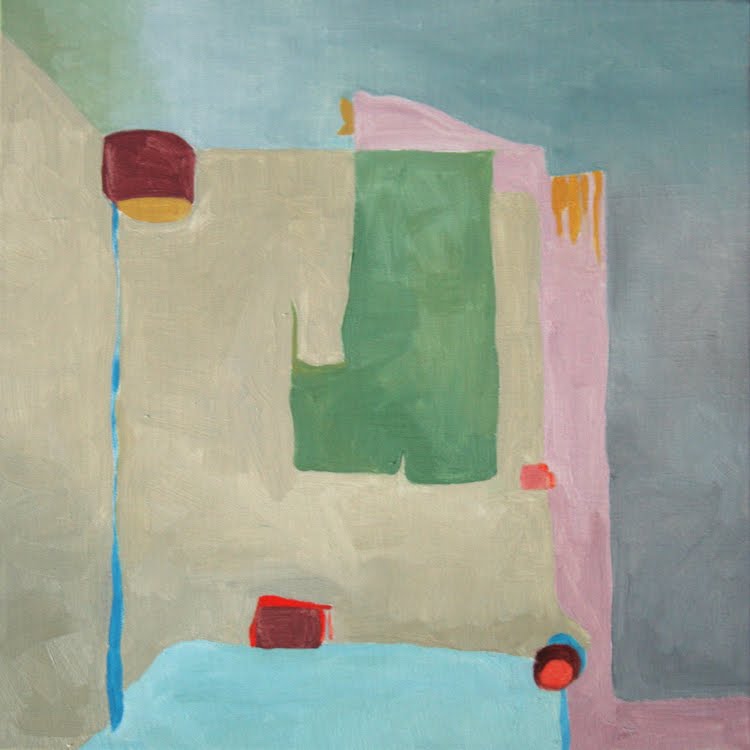
Barbara Marks’ canvases are remnants of what she has seen and experienced. These moments are then translated as her mind recalls them into colors and shapes, provoking the viewer to take note of the ordinary through her abstract approach. Through her work, she seeks to convey the sensation and memory of an experience.

Steve Crohn’s paintings use color to create an emotional response from their abstract relation to landscapes, feelings, situations, and ideas. He explores the variations in reference to the viewer's perception and challenges one to experience new feelings and ideas in reaction to his work. Through the dimension of color used in his work, the viewer can relate to and enjoy his paintings on multiple levels. He strives to create a universal emotional current, giving his work a profound presence.

Located on 96 Orange Street, the mission of Reynolds Fine Art is contribute to the economic and cultural ecosystem through vibrant samples of artwork, not only in our home neighborhood, but in the Lower Chapel district and in New Haven as a whole. Periodically, shows, demonstrations, lectures, workshops and art sessions will be held to infuse New Haven with the different aspects of the art world.

Labels: , , , , , ,

Monday, November 16, 2009

Tuesday evening opening at Gallery 195

Gallery 195
195 Church St., 4th floor (NewAlliance Bank), New Haven, (203) 772-2788
Barbara Marks & Vanilia Majoros
Nov. 17, 2009—Feb. 19, 2010
Artists' reception: Tues., Nov. 17, 5—7 p.m.

Press release

The Arts Council of Greater New Haven presents an exhibition of works by Connecticut artists Barbara Marks and Vanilia Majoros at Gallery 195 at NewAlliance Bank, 195 Church St., 4th floor, New Haven. The exhibition will be on display during bank hours from Nov. 17, 2009 through Feb. 19, 2010. An artists' reception is scheduled for Tuesday, November 17, from 5—7 p.m. The public is invited to attend.

This exhibition showcases lyrical paintings and prints by Connecticut artists Barbara Marks and Vanilia Majoros.

Painter Barbara Marks earned her BFA in 2005 from the Lyme Academy College of Fine Arts (Old Lyme) and her MFA in 2008 from Brooklyn College of the City University of New York. Marks' work has been exhibited in Connecticut, Massachusetts and New York, and at the Galleria Giotto in Italy 's Umbria region, where she studied at the International School of Painting, Drawing, and Sculpture. She is a member of Artspace's (New Haven) Board of Directors.

Art historian Vanilia Majoros earned her Ph.D. from the Hungarian Academy of Sciences. She has written six monographs about European modernists and had more than 100 scholarly articles published in Canada, France, Germany, Hungary and the United States. Her work has been shown in New Haven and Hungary and is included in private collections around the world. Majoros was a participating artist in the Arts Council's recent gala fundraising event Somewhat Off the Wall and is on the faculty of Creative Arts Workshop.

Labels: , , , ,

Monday, October 05, 2009

Quick notes from CWOS 2009, part 1

Artspace
City-Wide Open Studios
50 Orange St, New Haven, (203) 772-2709
City-Wide Open Studios
Oct. 24, 2009

With City-Wide Open Studios taking place within the compressed time frame of one weekend, I decide to start my sojourn over at West Cove Studios in West Haven (rather than have my entire Saturday given over to Erector Square). This site is notable both for the printmaking co-op founded by Roy Smith and for its vast expanses of walls well suited to function as gallery space.

My first stop is with sculptor Jonathan Waters. Waters' expansive studio has a view of the water. Through Oct. 18, he is sharing the wall space of his studio/gallery with painter Emilia Dubicki, showing his "Samurai" series of wall sculptures—both large and small works. Several of his large sculptures occupy floor space.

The smaller of these are made of wood veneer and black paper. They have the looping, geometric presence of Russian Constructivism. Waters tells me he calls them the "Samurai" series because of the motion they suggest.

"They're of the moment. Fragile, like our fragile existence," he says, bemused. In a sense, they are gestural sculptures, unlikely to hold together once removed from the wall on which they were created. That fact doesn't concerns Waters. "The mechanics of it is probably the least interesting art of it for me." It is the use of the materials and their receptivity to the forms he wants to create that interest Waters.

"And there is a kind of physicality involved in doing it. It's almost like a drawing that is three-dimensional," says Waters. "And I'm working out ideas. They're sort of sketches. For what, I don't know."

The larger sculptures share the sense of active energy even though they are constructed from harder, heavier, more substantial materials. Using primarily cut wood boards and plywood, selectively painted black, Waters clustered them in kinetic diagonals. They reveal themselves as the viewer walk around them.

Where Waters is working with blacks and natural wood grain tones, Emilia Dubicki's oil paintings pop with throbbing color. Like Waters' sculptures, they convey a sense of motion and their compositions owe a debt to geometric abstraction (although Dubicki considers them all "nature paintings").

"I paint fast. If I can't get the painting out in one shot, I want to walk away," she tells me. Referring to the painting "Miami Vice," Dubicki says, "I did walk away from this painting and came back another day." She notes that she used a palette knife and a plastic knife "to get a lot of blue on there." The use of the plastic knife is suggested by the lines in the paint left by its serrated edge. I ask about a pleasing accumulation of abstract detail in the lower left corner of the work.

"I try not to think about it too much. If it splatters and the splatter works, it stays," Dubicki says.

•••

I didn't get to meet the artist Barkev Gulessarian but a couple of his works riveted my attention. One was a large hollow sculpture, a Buddha with a dog head seated crosslegged in a robe and painted gold. It projected an odd, goofy serenity.

Gulessarian's other work that captivated me was a large "hippie painting," for lack of a better way of describing it. Painted on three large panels of plywood, it depicts a naked couple lounging toward the back of their pad with a large fetal figure in the foreground. A stereo system sits on the floor to the left. The pictorial details are rendered in simple black painted linework over large areas of poster style colors. The unpainted, exposed surfaces of the plywood are perfectly at home in the factory environment. The painting works because of the believabilty of the scene—Gulessarian's effective use of perspective and depth and the naturalistic flow of the figurative shapes. It should be scented with patchouli and outfitted with a psychedelic exploitation soundtrack.

•••

Anita Soos is showing a few large charcoal drawings in her "Water Walking" series, which she started in 2004. She tells me that she has been photographing water for 20 years.

"What I was interested in was capturing what water felt like," says Soos. "I wanted to get the feeling of what water was doing rather than seeing what water was doing. Water holds mysteries. It holds light, shadow, movements and events and layers."

She notes that one of the drawings, "Water Walking: Primary Disturbance," turns the imagery up on end. The drawing seems to pulsate. The idea of "water walking" turns water "into the event of what it does, walking across whatever surface you're looking at. I wanted it to have a more active role, a more poetic role than just saying what it was."

•••

While at West Cove I also have the opportunity to speak with artists Evie Lindemann and Barbara Marks about their works.

Lindemann, who is a professor of art therapy, is showing etchings, collage and a kind of prayer installation in the gallery space of the printmaking co-op. One series of her etchings is of different color prints of a New Age-y plate called "Mythic World," a piece she worked on while studying with the Mexican artist Gilberto Guerrero in the state of Guanajuata, located in the highlands 5 1/2 hours northwest of Mexico City. It features swirling imagery of an open hand (a reference to a serious hand injury Lindemann suffered a couple of years ago), a male figure, a large dove-like bird, fish forms and small figures that look like they are dancing or swimming. (Lindemann tells me they are actually pilgrims in a sacred Mexican church.) Explicating some of the symbolism, Lindemann tells me, "the bird is a transformational agent for me."

Barbara Marks says, "I love the idea of objective abstraction, not non-objective abstraction." What she is referring to in this case is using an iconic shape—a birthday cake—in a large series to evoke a range of emotions. It is a series on "temporality," in general. But specifically, the 75 monotypes of different birthday cakes is an homage to her husband who died at the age of 75 a couple of years ago. Marks notes that the imagery has a real effect on viewers.

"People will see the cakes and automatically start sharing stories about birthdays and the passage of time," she says.

•••

From West Cove I travel over to Erector Square, which easily absorbs the rest of the day. With a wealth of artists to visit and limited time, I don't bother with taking notes. High points include viewing Willard Lustenader's (Web) virtuoso oil paintings based on still lifes of paper cutouts; meeting and talking with Geoffrey Detrani (Web) about his layered drawings that juxtapose natural and architectural imagery; and Mary Lesser's (Web) gouache postcard paintings of scenes from her travels on the road.

Labels: , , , , , , , , ,