Dedicated to covering the visual arts community in Connecticut.

Monday, July 02, 2012

"Over Time," showcasing three artists, to have Sunday City Gallery reception

City Gallery
994 State St., New Haven, (203) 782-2489
Over Time: Works by Barbara Harder, Susan Newbold and Karen Wheeler
July 5—29, 2012.
Opening Reception: Sun., July 8, 2—5 p.m.
Closing Event: Sun., July 29, 2—4 p.m.

Press release

Over Time is a an exhibition introducing new gallery member, Susan Newbold (Web), along with gallery members Karen Wheeler (Web) and Barbara Harder (Web). Their mixed media and printmaking works evoke a sense of mystery/a passage of time/an invitation to linger.

Over Time will be on view from July 5—29 with an opening g reception on Sun., July 8, from 2—5 p.m. and a closing event on Sun., July 29, from 2—4 p.m.

Barbara Harder's JTopogC61:


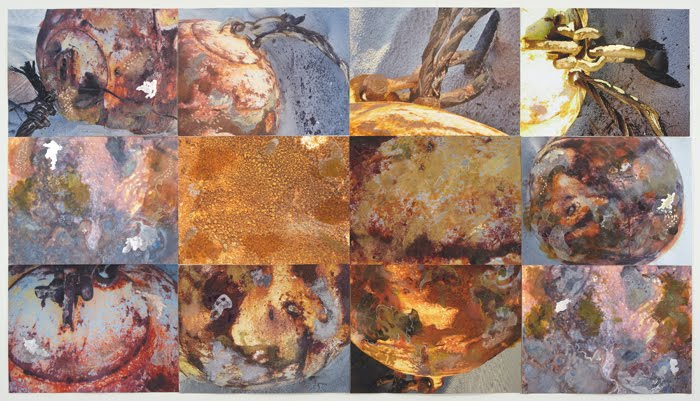
Susan Newbold's mixed media "Buoy":


Karen Wheeler's mixed digital work "Devotion":

Labels: , , , , ,

Wednesday, October 21, 2009

Barbara Harder show opens Saturday at City Gallery

City Gallery
994 State St., New Haven, (203) 782-2489
Barbara Harder: J Topog Continuum
Oct. 22—Nov. 15, 2009.
Opening reception: Sat., Oct. 24, 3—6:30 p.m.

Press release

City Gallery is presenting J Topog Continuum, a mixed media exhibition by artist Barbara Harder, from Oct. 22—Nov. 15, 2009. The Opening Reception is Saturday, Oct. 24 from 3—6:30 PM.

Based on observations of natural and man-made objects, Barbara Harder's artwork reflects her Irish Catholic upbringing married with a respect for the Asian sensibility. Using the image of a Tokyo tree and through the process of printmaking, Ms. Harder transforms the images onto paper, wood panels and veneers, and the tree is reconstructed into a new life. Some trees make there way across an old Concordia of the Bible to reflect her heritage, while others are printed onto layers of translucent, billowing paper that provide a interesting juxtaposition with the strong, angular wood reliefs. This installation of the disparate, yet related imagery, offers both a sense of serenity and of energy, inviting the viewer to explore the similarity of forms yet also to peek through layers to see exciting new spaces.

Barbara Harder teaches at Quinnipiac University and at Creative Arts Workshop, where she heads of the Printmaking Department. She has been a guest artist at the Yale University Art Gallery, Fairfield University, Connecticut College and the Center for Contemporary Printmaking as well as a curator of numerous printmaking exhibitions. Her artwork is held in private, corporation and museum collections throughout the country and she exhibits internationally.

Labels: , ,

Thursday, November 20, 2008

"Material Differences" opening Saturday at Amy Simon Fine Art in Westport

Amy Simon Fine Art
275 Post Road East, Playhouse Square, Westport, (203) 226-8232
Material Differences
Nov. 22, 2008—Jan. 3, 2009
Opening reception: Sat., Nov. 22, 5—7 p.m.

Press release

Amy Simon Fine Art, located at 275 Post Road East, Playhouse Square, Westport, is pleased to announce its latest exhibition Material Differences. The show features work by five artists who utilize nontraditional mediums in their work.

The artists in the show include: Meg Bloom, Barbara Harder, Nancy Lasar, Lauren Luloff and Robin Rapoport. These artists use a variety of unconventional materials, both from nature and manmade. Boundaries are broken and traditions are challenged.

Meg Bloom, primarily a sculptor, experiments with three-dimensional forms on two dimensional surfaces. She is concerned with space, color and texture in large and small scale work. Her imposing abstract forms, mounted on cardboard, are monumental reliefs that allude to organic forms in nature. They challenge the viewer to question what is being observed.

Barbara Harder is a process driven artist. She refers to her work as "excavations." Though she begins with pre-conceived notions of color and design, the process of making art transforms surfaces into surprising textures, shapes and tones. With the simplest of forms and materials, Harder creates extraordinary works of imposing stature. Surprises abound in her choices of medium, as well as the surfaces she works on.

Nancy Lasar's work incorporates abstraction and nature. Her calligraphic and gestural works are full of surprises. She paints, prints and even sews objects onto her open and fluid canvases.

Lauren Luloff, a young Brooklyn artist, creates explosive paintings on sheets which are cut, sewn and painted. They are awkward and emotional bursts of energy. Figurative forms are camouflaged by color, brushstrokes and patterns. Her works play an aesthetic game of hide and seek with the viewer.

Robin Rapoport incorporates wood, copper, rope, mesh and steel in her monumental works. As the founder of the Headless Whorse Dance Company, there is a natural flow of movement and rhythm in these unique and provocative pieces. In the tradition of Duchamp, they are both playful and complex. There is much beneath the surface of these works.

This is an exhibition for the curious minded. Preconceived notions of art mediums will be questioned. Visitors are invited to leave their traditions at the door and challenge themselves.

"Material Differences" is on view from Nov. 22—Jan. 3. There is an opening reception Saturday, Nov. 22, from 5 to 7 p.m.

Labels: , , , , ,

Thursday, October 02, 2008

City Gallery Line-Up to run concurrently with Open Studios

City Gallery
994 State St., New Haven, (203) 782-2489
Line-Up
Oct. 3—26, 2008 (with special extended hours City-Wide Open Studios' weekend)
Closing reception: Sun., Oct. 26, 2008, 2—5 p.m.

Press release

City Gallery is pleased to present Line-Up, a mixed media exhibit, by gallery members.
The exhibit is planned to run concurrently with City Wide Open Studios. The hours will be: Fri., Oct. 3, 12—8 p.m.; Sat., Oct. 4, 12—8 p.m.; Sun., Oct. 5, 12—5 p.m. The Closing Reception is Sun., Oct. 26, 2—5 p.m. Free.

The artists are working in all kinds of media: painting, photography, printmaking, sculpture, and each is responding to ideas about line.

The artists presenting are: Judy Atlas, Orange; Meg Bloom, New Haven; Phyllis Crowley, New Haven; Jennifer Davies, Branford; Nancy Eisenfeld, North Haven; Freddi Elton, Woodbridge; Barbara Harder, New Haven; Jane Harris, Madison; Sheila Kaczmarek, Guilford; Mary Lesser (see image), New Haven; Deborah McDuff, New Haven; Liz Pagano, New Haven; Jefri Ruchti, Guilford.

Labels: , , , , , , , , , , , ,

Saturday, December 01, 2007

City Gallery Give Art opening tomorrow

City Gallery
994 State St., New Haven, (203) 782-2489
Give Art
Nov. 24—Dec. 23, 2007.
Opening reception, Sun., Dec. 2, 12—4 p.m.

Tis the season, I guess, for abstraction. But that's usually the case at City Gallery in New Haven. For its annual year-ending holiday Give Art show, City Gallery members are showcasing a lot of smaller works. All the works are available for sale at the fixed price of $100 each. The full spectrum of materials and techniques employed by gallery artists is on display. Show participants include new members Deborah McDuff (mask making) and Freddi Elton (photography). This holiday season, City Gallery members are offering the opportunity to give the gift of art at an affordable price.

For the most part, the work is collage-based. Several artists incorporate found or non-traditional materials. (Although what might have been considered a non-traditional material in the past—a delicate twig as used by Meg Bloom, a torn piece of corrugated cardboard employed by Jane Harris, fine mesh screening added by Connie Pfeiffer, a strip of rough tree bark completing a Nancy Eisenfeld composition—is increasingly becoming the new norm.)

Deborah McDuff offers lively collages in which she creates masks out of things like cut-up soda cans, feathers, fabric and beads. There are some beautiful watercolors by Judy Atlas. Almost pastel-like, they radiate deep vibrant color. One, speckled with light blue dots, looks like some beautiful chaos attending the Big Bang or other cosmic event. Another (there was no sheet with titles available when I visited), in which washes and spatters of green range over a background of black, orange and cream, offers a convincing illusion of depth.

Jefri Ruchti's charcoal and/or graphite drawings revel in rich twists of light and shadow, suggesting natural if unidentifiable forms. With Freddi Elton's photographs, there is a sense of time in suspended animation. Her images zoom in close on layers of ice, capturing a vision of cracks, bubbles and needle-like forms.

The opening reception is Sun., Dec. 2, from 12—4 p.m.

Labels: , , , , , , , , , ,

Thursday, October 18, 2007

Barbara Harder opening at City Gallery on Sunday

City Gallery
994 State St., New Haven, (203) 782-2489
Barbara Harder: Seeing Through To...
Oct. 11—Nov. 18, 2007.
Opening reception, Sat., Oct. 21, 12—5 p.m.

Press release

The public is invited to the Opening Reception on Sun., Oct. 21, 12—5 p.m., as part of the City-Wide Open Studios 10th Anniversary celebration.

Barbara Harder says:

Seeing Through To... was motivated by a trip to Japan and the beautiful sensibility I found there. From the Imperial Gardens to the Ryoanji Temple, from small mountainside towns to ocean-side hot springs, from the bustling to the quiet and serene, these are the experiences that inspired this show.

Interested in excavating surface and uncovering space, I think of my work as topographic explorations. Responding to found objects and natural phenomena, I simplify their images and reconstruct the way one might view them in order to discover surprising places.

The icons from nature are printed on an assortment of Asian papers and presented in layered installations. The thin, soft Asian papers are constantly billowing and moving in space and seem to create another dimension, almost as if nature is breathing.
Seeing Through To... will culminate with a Closing Reception on Sun., Nov. 18, 1—4 p.m. to which the public is invited.

City Gallery, a contemporary art gallery is open to the public on Thursdays-Sundays from 12—4 p.m., or by appointment.

Barbara Harder heads the Printmaking Department at the Creative Arts Workshop in New Haven, CT and teaches at Quinnipiac University in Hamden, CT. She has been a guest lecturer/instructor at the Yale University Art Gallery and the Yale Center for British Art in New Haven, a visiting artist at Connecticut College in New London, CT, a consultant and instructor for the Center for Contemporary Printmaking in Norwalk, CT and a curator of numerous printmaking exhibitions. She exhibits internationally, most prominently at the Kyoto City Museum in Kyoto, Japan, the De Cordova Museum in Lincoln, MA, the University of Hawaii in Hilo, and the University of Connecticut in Stamford and Storrs, CT. She is the recipient of numerous awards and is represented in many private, corporate and museum collections.

Labels: , ,

Wednesday, October 17, 2007

Erector Square: Short takes

City-Wide Open Studios
50 Orange St., New Haven, (203) 772-2709
Erector Square: Short takes
Oct. 13. 2007.

There was a musical folk duo playing acoustic guitar and violin as I entered the Erector Square version of an alternative space. Eight artists were occupying the large open room, showing a potpourri of paintings, prints, photography and drawings.

I was immediately drawn to Dorothy Powers' work, a series of Xerox photo enlargements printed on canvas. According to Powers, they were taken on a windy beach. They depicted a woman in a black burka, struggling with the garment in the wind. Powers told me she "had to take the images almost nonstop because of the cold." The freedom of gestural figure drawing contrasted with the confinement of the garment.

"It started with my interest in little girls not going to school under the Taliban," Powers said. Investigating the plight of women in Afghanistan, Powers bought a burka on eBay. "I put one of these on and I couldn't see and couldn't breathe and I went into a rage."

The photographs were touched up with paint and charcoal. Powers said the images ended up being "kind of a combination."

"Starting with a point and shoot camera, because I'm not a photographer!" Powers said, laughing. "The beach, the wind and the burka."

•••

In a little room, almost a dead end hallway, off the main room, Deborah Zervas was showing a series of collaged landscapes. A landscape designer, Zervas told me that her approach to these works stemmed from her dissatisfaction with the traditional ways of representing spaces in landscape design.

She starts with a first layer of textured wallpaper and then adds layer after layer of paper—handmade, colored, textured, rich--to build the image.

"I want to find ways to put the viewer in the landscape. I thought texture might be a way to grab you and pull you in," she said.

A geologist before she became a landscape designer, Zervas relies on her deep knowledge of what underlies the visible surface in creating her collages. Several of the works depicted Western landscapes, specifically vistas of the Mojave Desert at the foothills of the Kingston Range.

"They are very real places I've worked as a geologist," Zervas said. Using photographs as starting points, she then works from memory.

There is an earthiness to the collages, brought out by the wisps of fibers—conjuring clouds in the sky or tenacious desert foliage in the parched earth—and the texture of the various papers. Delicate and deep, they are evocative of space.

•••

Ruth Sack was showing a number of paintings, including ones of leaves, flowers and butterflies. I was particularly struck by one beautiful abstraction, "Pastel Atmospheric." Rendered with encaustic and oil stick on birch board, it was densely textured with a built-up physicality of surface. A landscape of warm earthtone colors, Sack created effective contrasts with passages of soft purple and luminous turquoise.

•••

This was painter Eileen Eder's first Open Studios without an Erector Square studio to call home. Eder has built a studio at her shoreline home but returned to Erector Square to show in the Building 7 gallery. A series of landscape and still life paintings were displayed. A couple of drawings echoed still lifes.

"They are at opposite ends of the spectrum because this is shaping and color," Eder said, pointing to the paintings, "and this is pure line, with which I try and express the same thing."

The paintings have a warmth and grace. "East Rock No. 1," from Eder's New Haven park series, shows a path behind the Eli Whitney Barn. It beautifully conveyed the sense of entering into a darkening wood in fall.

•••

Printmaker Barbara Harder has long been interested in layered imagery, often sequencing inked cutout shapes on top of each other to create large works suggestive of topographical and geological forms. In recent years Harder has taken her fondness for layering further, combining her printmaking with a personal form of mixed media collage and installation.

In her small piece in the Main Exhibition, “J Topog 8,” there is a torn section of printed book paper included. Harder told me it was part of book of the Pentateuch, the first five books of the Bible, that she found in a French flea market.

"It was insect eaten when I bought it. I brought it home and put it in the freezer for three months to kill the insects," said Harder.

A lot of her works are inspired by a trip she took to Japan. She is printing on soft, translucent Asian papers and layering them to explore the juxtaposition of forms and colors. One of the works in progress included an image of a tree that Harder had photographed in Japan. She enlarged the image in Photoshop, erasing everything but the tree itself. The image was printed out on Mylar and a friend cut it out for her. The Mylar cutout was then inked and used in printing. In using the translucent, billowing papers, Harder is walking a fine line. While she likes it when her shapes are "a little hard to see," she wants to find the point at which they "pop" against a background.

Harder is also incorporating graphite line drawings in some of her works. I thought the pencil tracing that was part of “J Topog 8” was of a map. In fact, she is making tracings of ink that she has thrown on paper. The technique is an extension of her long-standing employment of the vagaries of printmaking to create the illusion of land masses and geography.

"I'm trying to find icons in nature, and sort of simplify and reconstruct them in some way to make something new to look at, in ways that a viewer wouldn't have thought of," said Harder.

•••

On facing walls of Fethi Meghelli's studio were works that testified to the breadth of his artistic vision. Three large charcoal drawings of faces melding into each other were draped on one wall. They are part of a continuation of his War Series, a commemoration of the victims of armed conflict. In front of the drawings, hanging from overhead pipes, were long slack strings of black yarn, representing tears. The installation's title is "Veil of Tears." It is a distillation of sadness and suffering.

But on the opposite wall was a work that radiates the joy of life. Like the faces in charcoal, the features of this young woman are rendered in Meghelli's signature style. Titled "Algerian Young Woman"—Meghelli seemed to be coming up with the title on the spot—it was painted on an Algerian pillow case that Meghelli opened up and used as a canvas. The colorful image was painted with acrylics and glitter and Meghelli added pins along her crown, a tiara of sorts. There is a rich stippling of colors, a background of gold and hair of glistening blue glitter. Her dress invites the eye with a wonderful richness of abstract color detail.

•••

What do you do if you have scraps of painted paper around? Victoria Branch engaged in some creative recycling. With leftover painted paper from an art theory class, and plastic mesh she had found years before in a dumpster, she created a series of collage paintings.

"I love color. It's very evocative. It brings feelings out of people," said Branch. Using acrylics stretched with soft gel, she paints her canvas in one color. Then she takes painted paper of a complementary color and rips it into strips.

One of the works is called "9/11" because its long angled strips of paper on the painted background are reminiscent of the jutting skeletal girders left after the World Trade Center buildings' collapse. Her husband told her "You're such a hippie!" because a couple of the works are titled "Purple Haze" and "Purple Sunshine."

"They start out fairly solid and you start ripping them up and putting them together and you get interesting patterns," Branch said of her method.

•••

In her blurb for the CWOS Artist Directory, Julie Fraenkel wrote, "I have an abiding interest in the physical embodiment of psychological states, the sense of the internal becoming visibly external." This can be seen in a quartet of moving portraits of young women on the wall next to her studio door.

Fraenkel paints her board with black gesso. She adheres a coating of thin yellow tissue, which she scrapes and draws on. To set off, the portrait, she adds another coat of black gesso in the background. The way the tissue adheres to the backing creates interesting organic textures. The faces seem to radiate feeling.

There was an interesting visual juxtaposition between the predominantly black and white portraits and a series of color paintings to their left. The paintings depict multi-layered domestic interiors. They are painted with flat mostly primary colors inside black lines, emphasizing a measure of rigid control, a formal contrast to the sketchy gesso and tissue works with their undercurrent of chaotic, turbulent emotion.

In each, five apartments are on top of each other. But in only one in each work, something momentous is happening—a moment of mythic passion, an angel swooping in on a baby, cherubs picking at a hollow-eyed lonely woman. The other apartments are empty, the world in a state of repose.

The paintings were inspired, in part, by Fraenkel's reading of an excerpt of Joan Didion's The Year of Magical Thinking.

"You think how strange it is that all these people are going on with their lives while she is going through this big moment," said Fraenkel. "Epic things are happening among normal places and you don't know. You're off in your own separate place."

Labels: , , , , ,

Saturday, October 13, 2007

CWOS opening night and checklist pleasures

City-Wide Open Studios Main Exhibition
50 Orange St., New Haven, (203) 772-2709
City-Wide Open Studios

It was a packed house last night at the opening reception for City-Wide Open Studios. Hanni Bresnick did a fine and creative job of laying out and organizing the main exhibition in Artspace's gallery. It is easy to cross-reference the checklist with the displayed works.

With the main exhibition reflecting the overall unjuried nature of CWOS, it can be hit or miss. But the hits far outnumber the misses, probably by a factor of 9 to 1, or better. My wife felt it was one of the strongest main exhibitions we've seen, and I'm inclined to agree.

The pleasure here is in looking at work and then scanning the checklist. Hmm. Christopher Beauchamp, a photographer I haven't heard of before, took the photo "Innocence." It looks Photoshopped to heighten the cinematic jolt of a young girl running through what might be a seriously decaying school corridor. Or, then there is Gregory Vershbow's C-print "Paperhill." Vershbow's photo is a somewhat surrealist image reminiscent of the works of Jerry Uelsmann. And one could go on and on in this manner, finding new artistic gems and recognizing the signature styles of old favorites.

Then there is the pleasure of seeing work by a familiar artist that explores new territory in still enjoyable ways, showing a seasoned artist taking risks. Printmaker Barbara Harder has increasingly taken to using translucent overlays in her works. I wasn't sure how I felt about this when I first saw works incorporating this device at a show at City Gallery (Harder has a new show there now). The overlays seemed to obscure her wonderful prints more than reveal new dimensions of meaning. But "J Topog 8," the mixed media piece in the main exhibition—wood block with geometric design, an overlay with map imagery in pencil and frazzled found printed newsprint—intrigued me with its artistic possibilities.

Labels: , , , ,